



“I was walking home from work when suddenly a guy with motorcycle came up behind me and grabbed my ass. This was the first time I had been physically assaulted.”
📍Cilandak.[1]
“As I was walking in a quiet street on a Sunday morning, a car pulled over and the driver started masturbating in front of me. He closed the door and waited until I left.”
📍Setiabudi[2]
“I was walking along Gandaria V Street, Kebayoran Baru, around 8 PM with my (male) partner, and a guy on a motorbike drove past and grabbed my chest.”
📍Gandaria[3]
To Be A Woman in Jakarta
Indonesia ranks fourth in the world as the most populated country, with women making up 49,6% of its population. Sadly, Indonesia placed 95th out of 167 in a ranking of the best countries to be a woman by National Geographic [4]. Women in Indonesia have been plagued with all sorts of dangers for decades; abuse, assault, abandonment, just to name a few. The wisdom of not being out alone late at night is still a mandatory inheritance for young girls all over the country.
Indonesia’s National Commission on Violence against Women (Komnas Perempuan) reported 431,471 sexual harassment cases against women. This number has increased 792%, or about eight times for the past twelve years alone. The commission has asked fervently for the government to take action, pushing preventative measures such as adding sex education to the curriculum. However, government intervention regarding the threats against half of the country’s population is still yet to be seen. Even until now the House of Representative hasn’t passed the sexual violence eradication bill despite public pressure.[5]

In line with the country’s 95th global ranking in the world’s best countries to be a woman, Indonesia’s capital, Jakarta, ranked 9th in the annual Thomson Reuters Foundation poll for the world’s most dangerous megacities for women in 2017.[6]
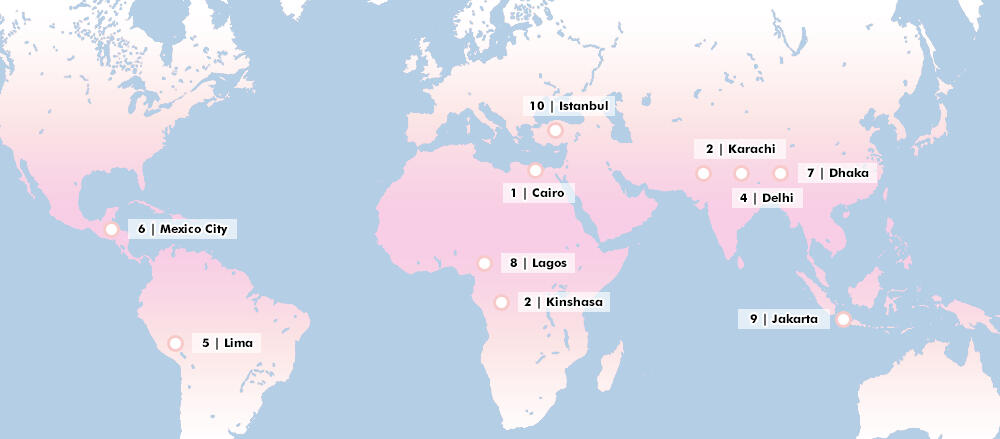
There are various of causes of these violence and harassment, ranging from cultural practices to lack of sex education and frail law. Indonesia is largely conservative. Sex is still considered a taboo to be talked about, and the youths are deprived of formal sex education beyond the very basic biology in schools.
Law also plays a big part in the untreated high numbers of sexual violence. Indonesia’s prevailing laws do not recognize the complexity of sexual violence. For example, The Criminal Code (KUHP) only recognize forcible penile penetration of woman’s vagina as rape. The law does not recognize other forms of sexual violence[7]. Even though many cases, especially sexual violence cases, involve more than just one form of violence.
The Concerning High Numbers of Violence
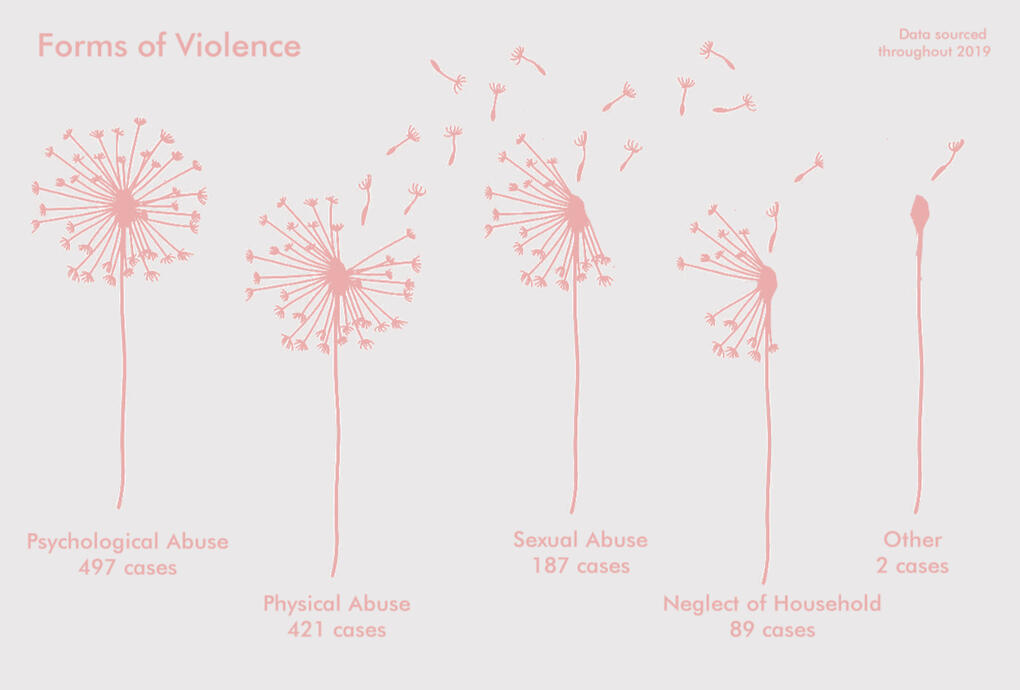
Among all forms of violence against women, in 2019, psychological violence had the highest number of reported cases in Jakarta according to the Integrated Services Center for Women and Children (Pusat Pelayanan Terpadu Pemberdayaan Peremuan dan Anak, or P2TP2A). This form of violence includes anything that is intentionally done by perpetrators that causes psychological harm to their victims, such as gaslighting, manipulation, exploitation, isolation, etc. With 497 total cases, psychological violence was followed by physical violence with 421 cases, sexual violence with 187 cases, household abandonment with 89 cases, and other forms with 2 cases[8].
Back in 2020, a Twitter thread depicting a horrible case of psychological and sexual violence went viral. The perpetrator, NC, kept forcing his girlfriend, R, to conduct unprotected sex. This was accompanied by the ridiculous demand that she didn’t take morning pills because ‘he didn’t want to deal with R being hormonal’. As a result, R had gotten pregnant four times. Each and every time, NC forced her to drink Misoprostol to abort the baby despite numerous side effects. It even got to the point that R had been forced to take too many Misoprostol pills that it induced heavy bleeding and blood vomiting.
He kept apologizing only to ask her for more sexual intercourses. At one point, he used his stress over the fact that he got caught smoking by his mother to force R to take the Misoprostol pills when she didn’t want to, because she shouldn’t add to his burdens, despite this being his fault. On another occasion, his mother took R to an illegal abortion clinic without her consent, enforced her to abort the baby and confiscated her phone so she couldn’t contact anyone for help[9]. This case enraged the netizens and soon enough these netizens exposed his identity to the public.
Identity
As shown in the previous tragic story, many perpetrators of violence against women are actually the people closest to them. According to P2TP2A, in 2019, spouses are the number one perpetrator of violence against women, with 370 cases out of 988 reports that the service center received.[10]
This number also checks out with another dataset that revealed domestic violence as the most common type of violence against women, with 457 cases reported.[11] The second most common perpetrator falls under the category of “others”. At 319 cases, this category of perpetrators includes acquaintances, friends, or even strangers. Boyfriends placed third at 90 cases and neighbours fourth at 77 cases. Last but not less horrifying, the data showed 76 cases of violence against women done by their parents and 56 cases by their family.[12]
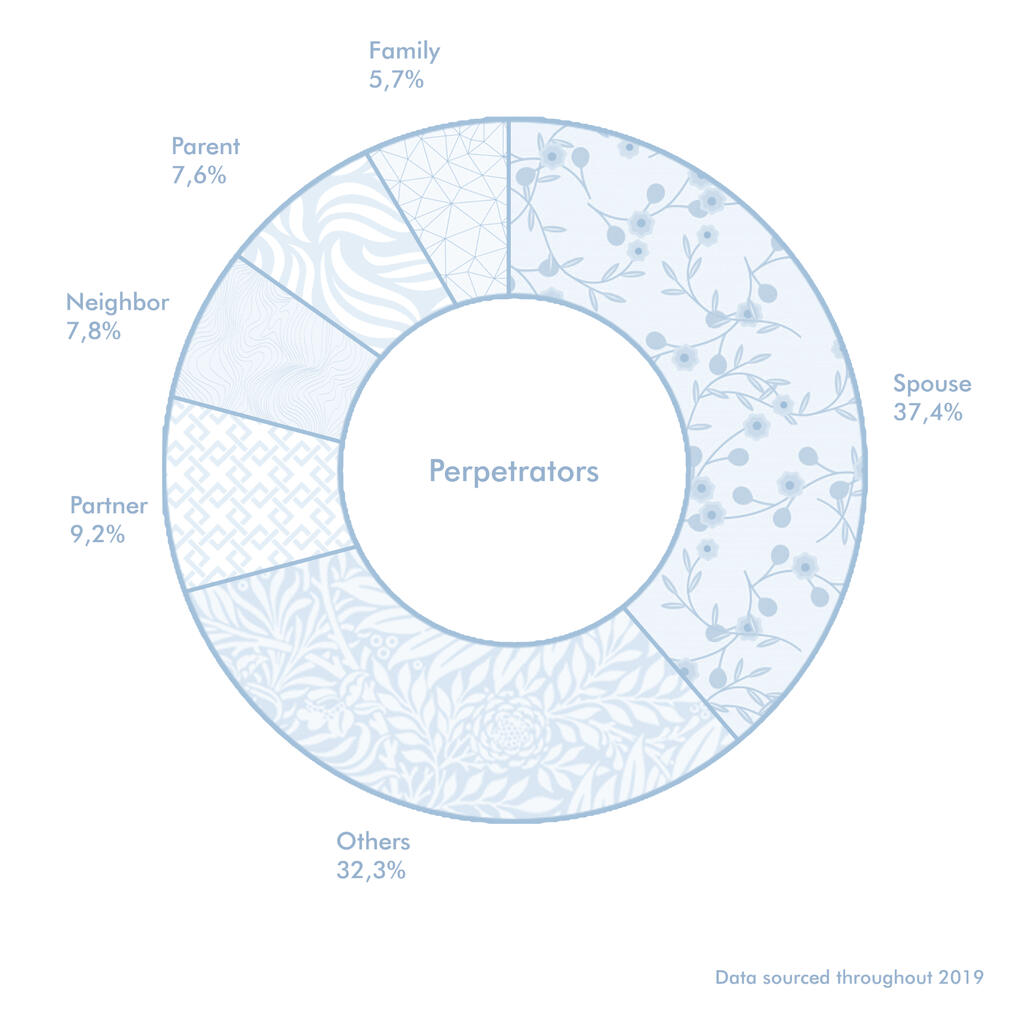
This number also checks out with another dataset that revealed domestic violence as the most common type of violence against women, with 457 cases reported.
This past year’s pandemic even poses a new sort of violence threat against women. Working from home has become a problem to women who are living with violent partners. They are isolated from others and from resources that can help them. They become trapped with their abusers in their own homes and have been exposed to increased violence.
Uli Pangaribuan, a lawyer representing a victim of domestic violence, told The Jakarta Post about how her team was contacted by a victim. She told Jakarta’s Legal Aid Foundation of the Indonesian Women's Association for Justice (LBH APIK Jakarta) that her husband had physically and sexually abused her during quarantine and she couldn’t flee because she had nowhere to go and he was watching her every movement. The victim sent messages to their hotline every morning or at noon when her husband was asleep, trying to be discreet. She forbade them to contact her out of fear that her husband, who had been working from home for the past three months, would notice. It took almost a month to finally help get her and her children out of the house and place them into a safe house.[13]
This is only a story from one victim out of many. They are afraid, abused, traumatized, and trapped for months. Even before the pandemic, the victims were struggling to get help because of the long process the authorities needed. These long processes prevent them from getting immediate help. Which is why some of them are debating.
Report It ... or Not?
The House of Representatives’ Legislation Body (Baleg) officially dropped the long-awaited sexual violence eradication bill (RUU PKS) from 2020’s National Legislation Program’s priority list, citing scheduling difficulties due to the Covid-19 pandemic. This bill is supposed to make the government responsible for giving victims sexual abuse protection and access to justice.[14]
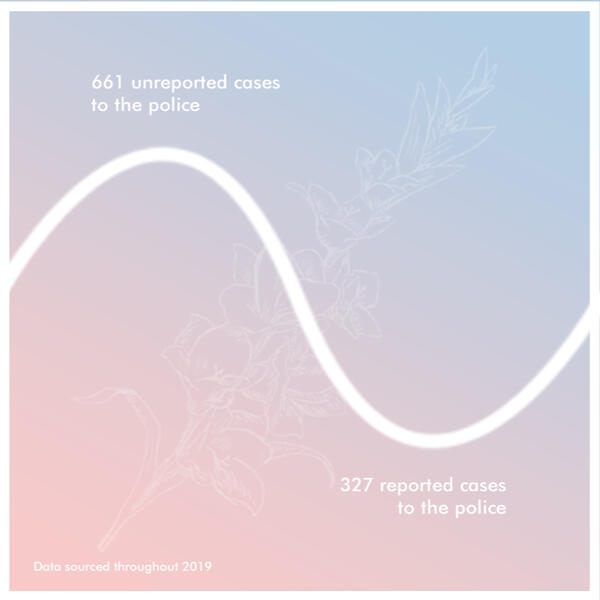
Out of 988 cases the P2TP2A received in 2019, victims from 661 cases chose not to involve authority.[15] This number is twice as many as the cases that eventually got the police involved. The victims’ distrust of the authorities to protect them and bring them justice is clear as day. According to Siti Mazuma, Director of LBH APIK, victims often don’t report the case because Indonesia's law still doesn’t take the victims’ side.
Amanda is a mother whose 16-year-old daughter was raped by her own father. She decided to report it to the police. She said it needed more than three hours at the police station to make the police investigation report. The policewoman who questioned her daughter didn’t show any remorse, and her daughter needed to answer the question while stuttering and sobbing. She felt like her daughter was being judged and felt like they were interrogating a thief rather than a victim.
Furthermore, Amanda still needed months to wait for her case to go into the next process after the police investigation report was done. The court sentenced the perpetrator to 13 years in prison. However, according to Amanda, her daughter was still traumatized for two years after the trial was over. Yes, they got the perpetrator to jail, but the existing system and stigma bullied her daughter into further trauma.[16]
Drastic measures are needed to create change. The fact that half of the population are more prone to become subjected to violence can not be allowed to continue. Jakarta as the nation’s capital needs to take charge; from those on the seat of government, to ordinary citizens like us, we all need to take part to form a stronger, safer society, and eradicate violence against women for good.
Annastasya Alifah / Dianka Rinya / Princessa Zahra / Shafira Farah
All data and research :
[1] https://www.ihollaback.org/blog/2018/03/12/walking-home-work/
[2] https://jakarta.ihollaback.org/2017/03/07/masturbated-at/
[3] https://jakarta.ihollaback.org/2017/01/08/gandaria/
[4] https://www.nationalgeographic.com/culture/2019/10/peril-progress-prosperity-womens-well-being-around-the-world-feature/
[5] https://komnasperempuan.go.id/pengumuman-detail/siaran-pers-dan-lembar-fakta-komnas-perempuan-cata#:~:text=CATAHU%202020%20merupakan%20catatan%20pendokumentasian,Komnas%20Perempuan%20sepanjang%20tahun%202019
[6] https://poll2017.trust.org/
[7] https://www.thejakartapost.com/academia/2020/07/04/difficulties-surrounding-sexual-violence-eradication-bill.html
[8] https://data.jakarta.go.id/dataset/data-korban-kekerasan-terhadap-perempuan-dan-anak-berdasarkan-bentuk-kekerasan-tahun-2019
[9] https://threader.app/thread/1240009050143617025
[10] https://data.jakarta.go.id/dataset/jumlah-korban-kekerasan-thd-perempuan-dan-anak-yang-ditangani-p2tp2a-berdasarkan-pelaku-kekerasan
[11] https://data.jakarta.go.id/dataset/data-korban-kekerasan-terhadap-perempuan-dan-anak-yang-ditangani-berdasarkan-jenis-kekerasan-2019
[12] https://data.jakarta.go.id/dataset/jumlah-korban-kekerasan-thd-perempuan-dan-anak-yang-ditangani-p2tp2a-berdasarkan-pelaku-kekerasan
[13] https://www.thejakartapost.com/news/2020/07/12/victims-of-domestic-violence-struggle-to-access-help-during-quarantine.html
[14] https://www.thejakartapost.com/news/2020/07/02/house-drops-sexual-violence-eradication-bill-from-this-years-priority-list.html
[15] https://data.jakarta.go.id/dataset/jumlah-korban-kekerasan-terhadap-perempuan-dan-anak-berdasarkan-yang-melapor-ke-kepolisian-2019
[16] https://www.bbc.com/indonesia/indonesia-41691743